

“The instant someone makes you doubt your own competence - stop. Two seconds ago, you had 25 years of experience.”
If a post I shared on LinkedIn this week is anything to go by, I appear to have accidentally touched a nerve. Over 120,000 impressions and counting, on the subject of toxic high billers in law firms and why nothing ever seems to be done about them. If you haven't seen it, I'll include the link at the bottom.
It was, in no small part, inspired by a conversation with my friend and fellow Female Lawyers’ Club member Clare Chappell, whose masterclass on narcissism in the workplace we hosted within the membership last week.
Before I get into the takeaways, one important caveat, and it's one Clare made herself at the very start of the session. The word "narcissist" gets thrown around a lot these days. Clare is not a psychologist, and nothing in this session was intended as a clinical diagnosis of anyone. Narcissistic behaviour can be described as being on a sliding scale. Some narcissism isn't necessarily "bad" - a great salesperson might be very keen to tell you how great they are. Narcissistic Personality Disorder is a serious condition, affects relatively few people, and can only be properly diagnosed by a qualified professional.
What Clare was describing, and what I think resonates so strongly with lawyers in particular, is a pattern of behaviour. You may have worked with someone who fits that pattern. That doesn't mean they have a personality disorder. It might just mean, as Clare put it, that they're not a very nice person.
With that said, here are the biggest takeaways from the session.
The narcissistic cycle looks the same at work as it does at home
Clare described three stages that will be depressingly familiar to many of you. First, the idealising phase, where you're the golden child, brilliant, full of potential, warmly welcomed. Then, something shifts. You go on maternity leave and come back. You push back on something. You stop being quite so available. And suddenly you're in the devalue phase, where the feedback becomes vague yet negative, the goalposts move, and you find yourself apologising for things you're not sure you even did, let alone that you did them wrong. Finally, the discard phase, which in a workplace context means a performance improvement plan, a disciplinary process, or the newer phenomenon "quiet firing", being sidelined, excluded, and made so uncomfortable that leaving feels like your own idea.
Gaslighting is more specific than people think
The term comes from a 1940s film in which a husband manipulates his wife into doubting her own perception of reality. In a workplace context, Clare described it as subtle but systematic, making you doubt your recollection of events, shifting blame, moving goalposts, and forcing you to defend yourself. Clare referenced The Gaslight Effect by Dr Robin Stern, whose advice is not to take the bait. Once you start defending yourself in detail, you give the other person more material to pick holes in. Instead, simply note that your recollections differ, and leave it there.
It hits lawyers particularly hard
This was the part of the session I found most interesting, because it explains something I've observed for years. Lawyers are, by training and temperament, perfectionists. We are used to being competent. We are used to being right, or at least to arguing our position convincingly. So when someone in authority tells us, repeatedly and with apparent certainty, that we are getting things wrong, it is profoundly disorienting. Add to that the hierarchical structure of most law firms, the financial vulnerability (especially that of coming back from maternity leave), and the fear of what speaking up might do to your career, and you have a situation where extremely capable, experienced women end up doubting themselves completely. Clare called it discombobulation, and I think that word is spot on here.
The practical options are limited, but they exist
Clare was honest about this. Raising a formal grievance when your manager is the problem is genuinely difficult, not least because, as she put it, provoking the red mist in someone who is never wrong, and is very good at arguing, is a significant risk. Her practical advice was this: get legal advice early, even just a conversation. Start documenting things. Have an exit plan before you start any formal process. And know that for many people in this situation, a quietly negotiated exit deal is not a defeat. It is a sensible, strategic decision that helps you feel that you have some control in how you move forward.
The wider picture
One thing Clare said that stayed with me, and I say this as someone who has my own experience of this, is that the reason these patterns persist in law firms is not that nobody notices. It’s that nobody acts. I worked alongside a partner for eleven years whose behaviour was, frankly, egregious. He billed well, so nothing happened. He was eventually managed out, more than twenty years into his time at the firm. I have no idea what finally tipped the balance. But I think about the people who left during those years, and what that actually cost the firm, in ways that never appeared on a spreadsheet.
Which brings us back, neatly, to that LinkedIn post. You can read it here.
The John Amaechi quote that runs through both the post and this blog is worth repeating here. “Culture is defined by the worst behaviour tolerated.” Not the values on the website, or the shiny policies and EAPs. It's about the behaviour that leadership looks at, and decides to let pass.
Clare's session gave us the language to describe what that looks like from the inside. I hope it's useful.
If you would like to contact Clare
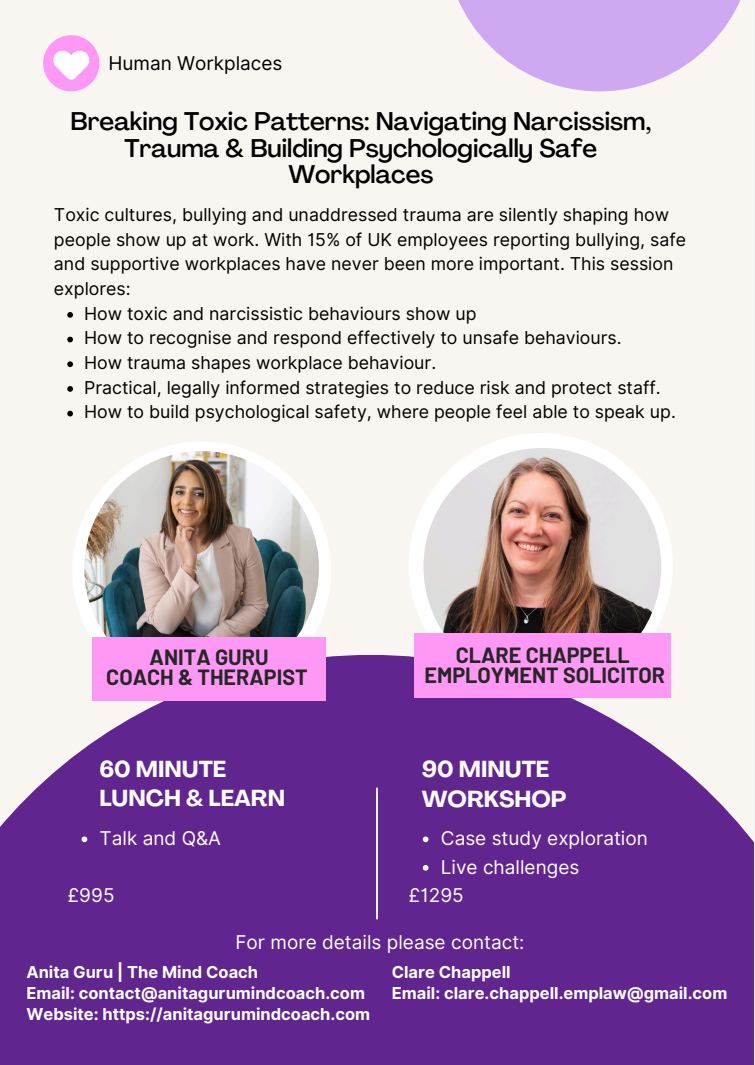
Clare Chappell is an employment lawyer with over 25 years' experience advising both employers and senior executives on complex workplace issues. She also delivers workplace sessions on narcissism, gaslighting and psychological safety, alongside coach and therapist Anita Guru. If you would like to find out more about bringing Clare and Anita into your firm, you can reach Clare at:
Clare and Anita’s flyer is below, in case it’s of interest.
Enjoy the rest of your week.
Rachel